
Meta Ads AI Connectors Are Open. The Hard Part Is Still Knowing What To Do Next.
Meta has opened Ads AI Connectors in beta. Here is what marketers can do now, where the risks sit, and why cross-channel context still matters

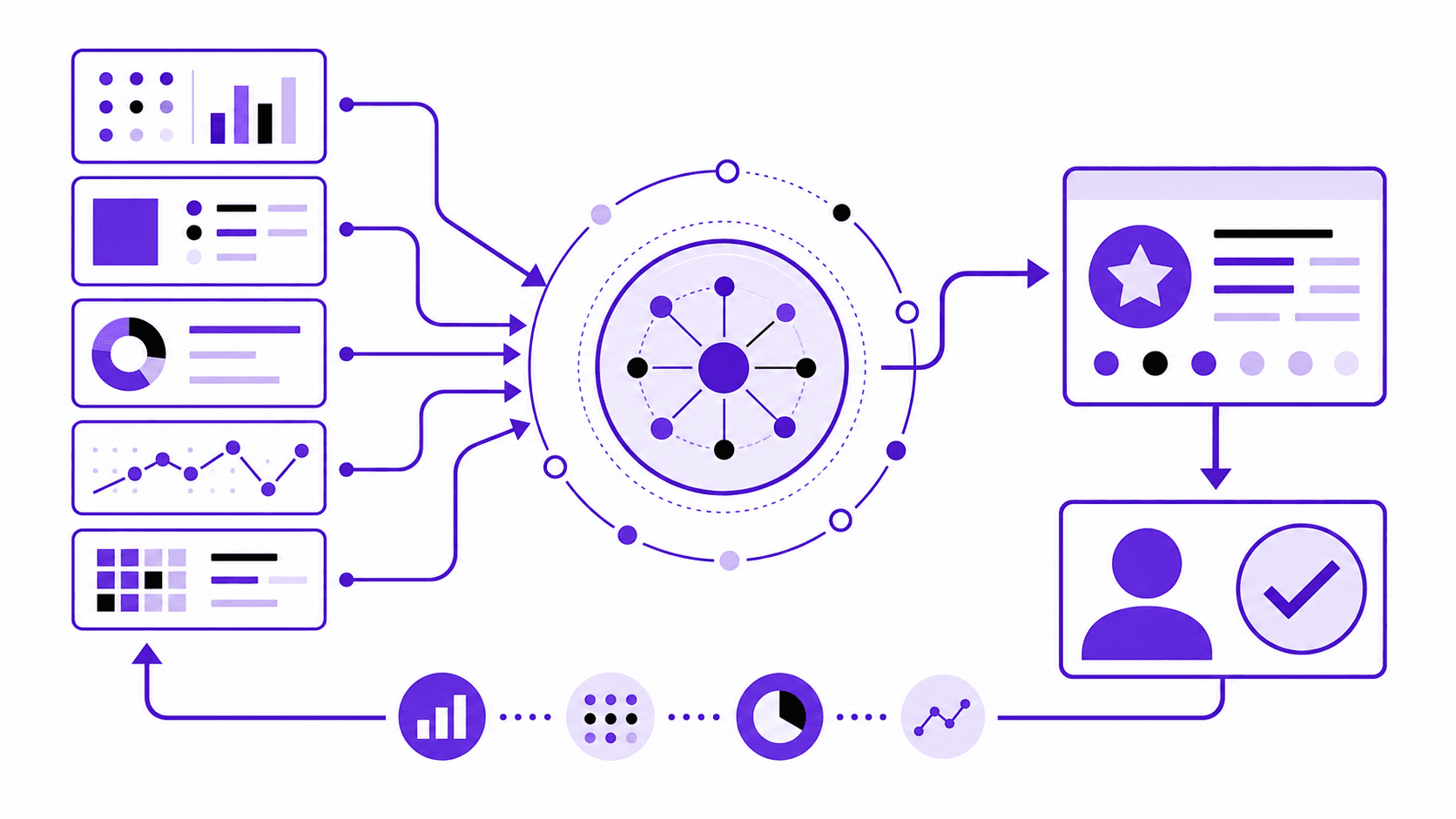
Featured image alt text: Abstract marketing workflow showing separate AI tools connecting through a secure campaign-context layer to a reviewed advertising dashboard.
Meta has opened its Ads AI Connectors in beta.
That matters. Not because marketers suddenly need another AI chat window. It matters because Meta is making its ad system available inside the AI tools people already use.
You can ask an AI assistant to pull a report, investigate an audience signal, create a campaign structure, work with catalog data, or diagnose signal quality. Meta says this happens through its Ads MCP server and Ads CLI, with a Meta-authenticated connection to real account data.
The interface is changing.
The hard part is not.
A marketing team still needs to decide what a performance change means. It still needs to know which business constraint matters more than a platform metric. And it still needs to decide which recommendation should become a live change.
That is where the real work starts.
What Meta Ads AI Connectors actually open up
Meta’s open beta lets eligible advertisers and agencies create, manage and analyse campaigns from AI tools they already use. Meta positions the connector as a secure, authenticated bridge to campaign performance, campaign creation, catalog management, audience insights and signal diagnostics.
The immediate benefit is speed.
A performance lead can ask for a 14-day performance story instead of exporting three reports. An agency can turn a client’s question into a first draft of an account review. A commerce team can inspect catalog or feed issues without bouncing between tools.
That sounds useful. It is useful.
But a faster answer is not automatically a better decision.
The capability is real. The decision boundary is still yours.
Meta’s update on 16 July added two important parts to the story:
- businesses can connect their own developer app for deeper integrations;
- people with full control of a business portfolio can use Ads MCP server rules to govern what AI agents can do, including budget changes and catalog updates.
That second point deserves more attention than it will get.
The industry is moving from “Can an AI inspect my ads account?” to “What exactly is this AI allowed to change?”
Those are not the same question.
Why this is bigger than a Meta integration
For years, ad platforms have competed to become the place where work happens.
MCP changes the direction of travel. It lets the conversation move into the marketer’s chosen AI environment, while the platform provides controlled access to its data and actions.
Meta is explicit about the split:
- use its in-product business assistant for guidance inside Ads Manager;
- use Ads AI Connectors for cross-channel insights and custom workflows in the tools you already use.
This is the right distinction.
No serious marketing question lives cleanly inside one publisher.
“Why did CPA rise?” is rarely only a Meta question. It can be a landing-page question, a creative-fatigue question, a sales-quality question, a branded-search question, or a measurement question. Often it is several at once.
A Meta-only answer can be accurate about Meta and still incomplete about the business.
The report was not wrong. It was incomplete.
The new bottleneck is context
Better models and better connectors make it easier to generate outputs. They do not supply the missing context behind a marketing decision.
Consider a familiar Monday-morning problem:
- Meta CPA is up 28% week on week.
- CTR has barely moved.
- The landing-page conversion rate has fallen.
- Google branded-search volume is down.
- Sales says lead quality changed after a pricing update.
- The creative team says the latest ad has the strongest hook rate in the account.
An assistant connected only to Meta could reasonably recommend cutting the expensive ad sets.
A team looking at the full picture might reach a different conclusion. The real issue could be a landing-page or offer mismatch. Killing the creative may remove the one part of the funnel that is still working.
This is why model access is not the product.
The product is a decision system that can connect the signals, preserve the constraints, show its evidence, and pause before the irreversible step.
A practical way to start with Meta Ads AI Connectors
The safest first move is not to hand an AI agent a budget dial.
Start with three layers.
1. Read: use it as an analyst
Ask the connector to retrieve facts and explain patterns. Keep it read-only.
Useful early questions:
- “Compare the last 14 days with the prior 14 days. Explain changes in spend, purchases, CPA and ROAS. List the biggest movements and the evidence behind each.”
- “Show active ads with meaningful spend where performance has deteriorated. Separate possible creative fatigue from changes in targeting, delivery or conversion volume.”
- “Find catalog or signal-quality issues that could affect delivery. Do not make any changes.”
The goal is not to judge the model on whether it sounds persuasive. It is to learn where its account-level read agrees or disagrees with your team.
2. Prepare: let it draft, not publish
Once the team trusts the diagnostic layer, use the connector to prepare a proposal.
That might be a paused campaign structure, a capped audience test, a creative brief based on verified winners, or a client-ready weekly summary.
The proposal should carry its assumptions:
- What data did it use?
- What did it exclude?
- What outcome is it optimising for?
- What could make the recommendation wrong?
- Which person must approve it?
A draft with its reasoning is useful. A silent change is not.
3. Govern: make the rules visible
Meta’s new MCP rules make this a practical operating question, not a theoretical one.
Decide in advance:
- which roles can connect an AI agent;
- which tools have read, draft or write permissions;
- the maximum budget or catalog change that can be proposed;
- who approves material changes;
- where prompts, outputs and executed actions are logged;
- what the agent must do when evidence conflicts or confidence is low.
Do not wait for the first bad recommendation to define the process.
What agencies should take from this
The superficial reading is that AI will reduce the value of agency work.
I think the opposite is more likely.
The manual assembly of reports, screenshots and first-pass account checks will become cheaper. Good. It should.
The agency value that compounds is the ability to turn scattered evidence into a better decision, explain the trade-off to a client, and keep a safe operating cadence across many accounts.
That is not “more prompting.” It is a stronger operating system.
An agency that uses these connectors well can spend less time pulling numbers and more time doing the work a client actually values:
- diagnosing whether a platform signal is a real business problem;
- connecting creative, media, funnel and sales evidence;
- turning a recommendation into a test with a clear owner and guardrail;
- learning from the outcome across accounts without copying one client’s playbook into another.
The agencies that struggle will be the ones still selling the manual production of an update. The agencies that win will be the ones that become evidence-backed decision partners.The superficial reading is that AI will reduce the value of agency work.
I think the opposite is more likely.
The manual assembly of reports, screenshots and first-pass account checks will become cheaper. Good. It should.
The agency value that compounds is the ability to turn scattered evidence into a better decision, explain the trade-off to a client, and keep a safe operating cadence across many accounts.
That is not “more prompting.” It is a stronger operating system.
An agency that uses these connectors well can spend less time pulling numbers and more time doing the work a client actually values:
- diagnosing whether a platform signal is a real business problem;
- connecting creative, media, funnel and sales evidence;
- turning a recommendation into a test with a clear owner and guardrail;
- learning from the outcome across accounts without copying one client’s playbook into another.
The agencies that struggle will be the ones still selling the manual production of an update. The agencies that win will be the ones that become evidence-backed decision partners.
Where Thirdi fits
At Thirdi, we think of the model and connector as an access layer, not the complete marketing system.
The useful layer is the one that brings together cross-channel performance, creative and funnel context, historical learning, business constraints and a clear human approval boundary.
That is why our view has been consistent: winning with AI agents has very little to do with the model you pick. A stronger model is valuable. A better-connected and better-governed system is what makes it useful in real marketing work.
If you are beginning with Meta MCP, start by treating it like an analyst, not a buyer. Then put its findings beside the rest of the customer journey.
For teams that need to work across publishers, the next question is not “Can I ask an AI about Meta?” It is “Can I make a decision without losing the Google, creative, funnel and business context that makes Meta’s answer meaningful?”
That is the job of a marketing context layer.
Thirdi’s agency operating layer is built for that work: turning scattered data into ranked, evidence-backed actions while keeping the accountable person in control.
A simple 30-day rollout plan
Week 1
Objective: Learn the account read
Safe use of the connector: Read-only trend, waste, creative and signal diagnostics
Human responsibility: Validate every conclusion against the existing workflow
Week 2
Objective: Test proposal quality
Safe use of the connector: Draft reports, test ideas and paused campaign structures
Human responsibility: Check assumptions, caps and customer impact
Week 3
Objective: Create governance
Safe use of the connector: Define permissions, limits, logs and escalation rules
Human responsibility: Approve the operating policy and owners
Week 4
Objective: Run limited tests
Safe use of the connector: Execute small, pre-approved changes with measurement plans
Human responsibility: Review outcome, revise the guardrails
The shift to watch
Meta has made it easier for AI agents to work with its advertising system.
That will change how fast teams can inspect, draft and manage campaign work. It should reduce a lot of low-value clicking.
But it also raises the standard.
When every team can ask an assistant to generate an account summary, the advantage moves to the team that knows what to ask, what context to supply, what not to automate, and how to learn after a decision is made.
The connector is open.
The operating system behind it is now the differentiator.
FAQ
What are Meta Ads AI Connectors?
Meta Ads AI Connectors are an open-beta set of connections, including Meta’s Ads MCP server and Ads CLI, that let eligible advertisers and agencies create, manage and analyse Meta campaigns from AI tools they already use. Meta says the connection is secure and Meta-authenticated.
Can Meta Ads AI Connectors change campaign budgets?
Meta says its connectors can support campaign-management workflows, and its July 2026 update introduced MCP server rules to govern what AI agents can do, including budget changes. Teams should decide permissions and approval limits before enabling write actions.
Should marketers let an AI agent run Meta ads automatically?
Start with read-only analysis. Next, use AI to prepare drafts or paused structures. Only consider controlled execution after the team has validated the agent’s account read, defined clear guardrails and assigned human approval ownership.
Why is cross-channel context important for Meta campaign decisions?
A Meta performance change can be affected by creative, landing-page conversion, sales quality, Google search demand, attribution and other factors outside Meta. Cross-channel context helps a team avoid optimising a platform metric at the expense of the business outcome.
See this on your own accounts
third i connects to the platforms you already run and does this work against your live numbers.
Read more
View all articles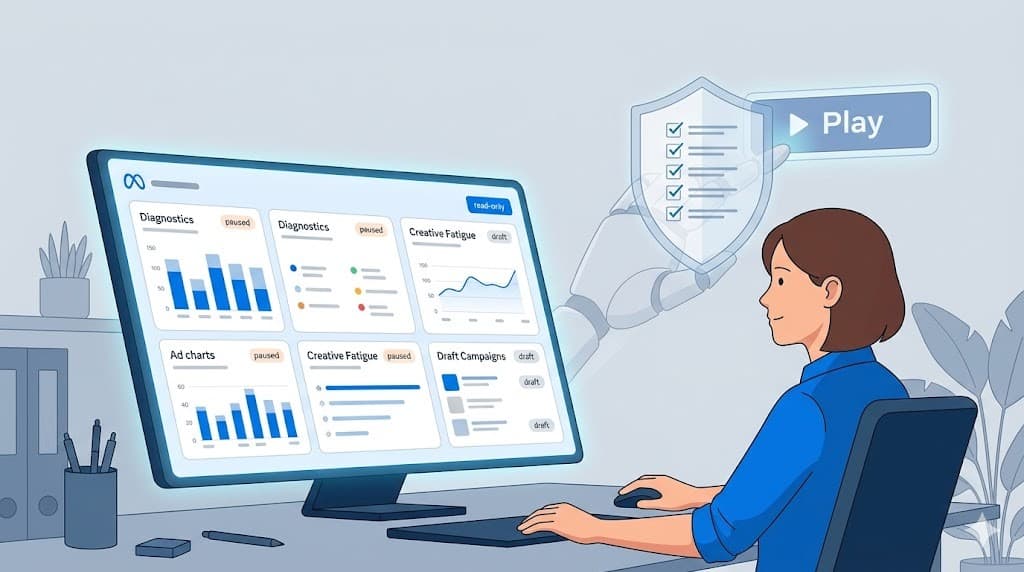
Treat Meta MCP Like An Analyst, Not A Buyer: Three Low‑Risk Ways To Start
MCP gives you a powerful AI layer inside Meta, but the risk is simple: it can move faster than your brand is ready for.
